


Table of Contents
Introduction
Milling machine cutter types are one of the most critical variables in modern machining. Regardless of whether the operation involves rough stock removal or high-precision finishing, the cutter determines how efficiently material is removed, how stable the cutting process remains, and how consistent the final part quality will be. Many machining problems, such as vibration, poor surface finish, or excessive tool wear, originate from incorrect selection of milling machine cutter types rather than machine or parameter issues.
This article provides an in-depth explanation of milling machine cutter types, their working principles, and how to select them based on material, operation, and machine capability.
Why Milling Machine Cutter Types Matter
Different milling machine cutter types are engineered to manage cutting forces, chip formation, and heat in different ways. When a cutter is correctly matched to the application, cutting forces are distributed evenly, chips evacuate smoothly, and heat is controlled at the cutting zone.
Incorrect milling machine cutter types often lead to tool deflection, chatter, or premature wear. Over time, this reduces productivity and increases tooling costs. Understanding cutter behavior allows machinists and engineers to optimize tool life while maintaining tight tolerances.
End Mills
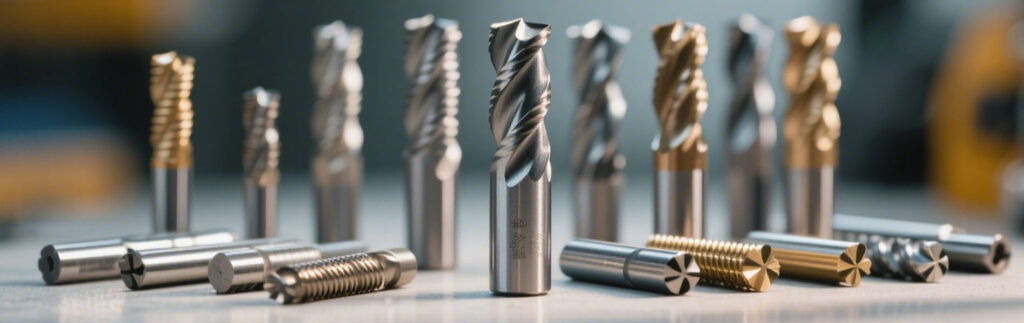
End mills are among the most versatile milling machine cutter types and are used across a wide range of industries. They can cut axially and radially, making them suitable for slotting, pocketing, profiling, and contouring.
The performance of end mills depends heavily on flute count, helix angle, and cutter length. Fewer flutes allow better chip evacuation in softer materials, while higher flute counts improve rigidity and surface finish in harder materials. In CNC machining, end mills are often selected based on a balance between material removal rate and surface quality.
Proper end mill selection significantly reduces vibration and improves dimensional accuracy, especially in deep cavities or narrow slots.
Face Milling Cutters
Face milling cutters are designed specifically for machining flat surfaces with high efficiency. These milling machine cutter types use multiple cutting edges, often indexable inserts, to distribute cutting forces evenly across the cutter body.
They are widely used in production environments because they offer excellent surface finish while maintaining high feed rates. Insert-based face milling cutters also offer economic advantages, as worn inserts can be replaced without requiring a change to the entire tool.
The performance of face milling cutters is influenced by insert geometry, lead angle, and cutter diameter. Selecting the correct configuration helps reduce spindle load and improve surface consistency.
Slab Milling Cutters
Slab milling cutters are traditional milling machine cutter types primarily used on horizontal milling machines. They feature a large cutting diameter with teeth along the circumference, enabling aggressive material removal.
These cutters are particularly effective for rough machining operations where stability and rigidity are required. Their large contact area allows them to handle high cutting forces with minimal deflection.
Although less common in modern CNC machining, slab milling cutters remain relevant for heavy-duty operations and long, straight surface machining.
Side and Face Cutters
Side and face cutters are milling machine cutter types designed for machining slots, grooves, and shoulders in a single pass. They feature cutting edges on both the periphery and sides, allowing precise control of slot width and depth.
These cutters are commonly used in applications where dimensional accuracy is critical, such as keyways or structural components. Their rigid design minimizes lateral deflection, which is essential for maintaining tight tolerances.
T-Slot Cutters

T-slot cutters are specialized milling machine cutter types used to create T-shaped slots in machine tables, fixtures, and clamping systems.
The machining process typically involves two steps: first, a straight slot is created using an end mill, and then the T-slot cutter enlarges the lower portion of the slot. Due to the cutter’s geometry, proper alignment and stable cutting conditions are crucial to prevent tool breakage.
Ball Nose Cutters
Ball nose cutters are essential milling machine cutter types for three-dimensional contouring and finishing operations. Their rounded tip allows smooth transitions across complex surfaces, making them ideal for molds, dies, and curved components.
While ball nose cutters are not designed for heavy material removal, they excel in finishing passes where surface continuity and precision are required. Tool path strategy plays a major role in achieving optimal results with these cutters.
Roughing Milling Cutters
Roughing cutters are designed to remove large volumes of material quickly. Their serrated cutting edges break chips into smaller segments, reducing cutting forces and heat buildup.
These milling machine cutter types are commonly used in the early stages of machining to prepare workpieces for finishing operations. By reducing overall machining time, roughing cutters significantly improve production efficiency.
Comparison of Common Milling Machine Cutter Types
| Milling Machine Cutter Types | Primary Function | Typical Application | Key Advantage |
|---|---|---|---|
| End Mills | Slotting, profiling | General CNC machining | Versatility |
| Face Milling Cutters | Surface milling | Flat surface finishing | High efficiency |
| Slab Milling Cutters | Heavy cutting | Rough machining | Stability |
| Side and Face Cutters | Slot machining | Grooves and shoulders | Accuracy |
| Ball Nose Cutters | 3D contouring | Mold and die work | Smooth surfaces |
Matching Milling Machine Cutter Types to Materials
Material properties such as hardness, ductility, and abrasiveness directly affect cutter performance. Softer materials benefit from sharp cutting edges and fewer flutes, while harder materials require rigid milling machine cutter types with wear-resistant materials and coatings.
Selecting the correct cutter geometry improves chip control and reduces thermal stress, leading to longer tool life.
Machine Capability and Cutter Selection
Machine rigidity, spindle power, and tool holding systems define which milling machine cutter types can be used effectively. High-speed CNC machines can fully exploit advanced cutter designs, while less rigid machines require conservative cutter selection to maintain stability.
Matching cutter type to machine capability prevents chatter and enhances process reliability.
Common Mistakes When Choosing Milling Machine Cutter Types
Using finishing cutters for roughing operations
Ignoring machine rigidity and spindle limitations
Selecting incorrect flute count for the material
Overlooking cutter coating and base material
Avoiding these mistakes leads to better machining outcomes and lower costs.
FAQ
What are the most common milling machine cutter types?
End mills, face milling cutters, slab cutters, and ball nose cutters are widely used.
Which milling machine cutter types are best for CNC machining?
End mills and indexable face milling cutters are commonly preferred.
How do milling machine cutter types affect tool life?
Proper selection reduces wear, heat, and vibration, extending tool life.
Can one milling machine cutter type replace others?
No, different operations require specialized cutter designs.
Do milling machine cutter types influence surface finish?
Yes, cutter geometry and stability directly impact surface quality.
Conclusion
Milling machine cutter types are fundamental to machining efficiency, accuracy, and cost control. A deep understanding of cutter behavior allows manufacturers to optimize processes and achieve consistent results.
If you need expert guidance or customized milling solutions, contact Shandong Tool to support your machining applications with reliable and high-performance cutting tools.


 English
  Russian
  German