

Table of Contents
Introduction
In the field of precision machining, the performance of CNC cutting tools is not only determined by the base material but also by the quality of the surface coating. Modern tool coating technologies have dramatically transformed how manufacturers approach tool longevity, machining speed, and production efficiency.
A high-quality coating acts as a microscopic armor—protecting the tool surface against friction, heat, and chemical reactions during high-speed cutting. Whether you are machining hardened steel, aluminum, or composite materials, the right coating can make a measurable difference in both productivity and cost efficiency.
This article explores the most advanced tool coating technologies for CNC cutting tools, their benefits, applications, and how to choose the right coating for your production requirements.
Why Tool Coating Matters in CNC Machining
Every CNC cutting operation generates heat, friction, and pressure. Without protection, the cutting edge quickly wears out or softens, leading to poor dimensional accuracy, rough surfaces, and increased tool replacement costs.
According to Machining Science and Technology Journal, coated CNC cutting tools can last up to three to five times longer than uncoated tools. Moreover, coated tools enable manufacturers to operate at 20–30% higher cutting speeds while maintaining tight tolerances.
The coating acts as a shield that:
- Reduces adhesive wear between the tool and workpiece
- Prevents oxidation at high cutting temperatures
- Improves chip evacuation and surface quality
- Enhances the thermal stability of the tool material
Simply put, tool coatings make machining faster, cleaner, and more predictable.
Common Types of Coatings for CNC Cutting Tools
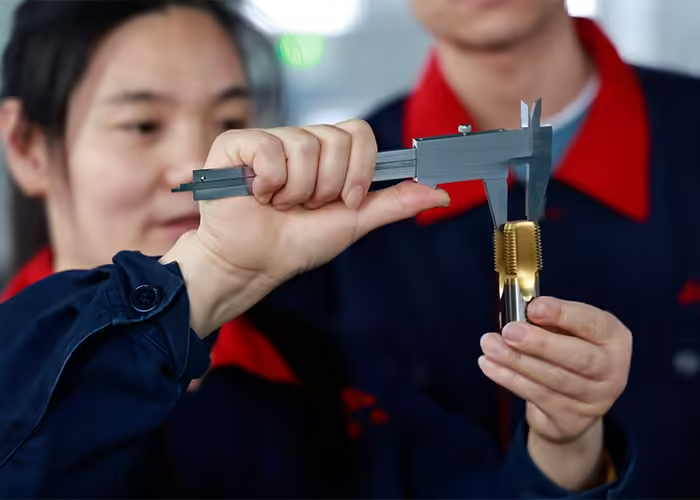
Modern coating technologies use advanced processes such as PVD (Physical Vapor Deposition) and CVD (Chemical Vapor Deposition) to deposit ultra-thin films on the tool surface. These films, usually between 2–5 microns thick, provide hardness, heat resistance, and chemical stability.
| Coating Type | Composition | Deposition Method | Ideal Applications | Main Advantages |
|---|---|---|---|---|
| TiN (Titanium Nitride) | Titanium + Nitrogen | PVD | General-purpose machining | Low friction, gold color, cost-effective |
| TiAlN (Titanium Aluminum Nitride) | Titanium + Aluminum + Nitrogen | PVD | High-speed dry cutting | Excellent thermal resistance |
| AlTiN (Aluminum Titanium Nitride) | Aluminum-rich alloy | PVD | Hard steel, stainless steel | Superior oxidation resistance |
| CrN (Chromium Nitride) | Chromium + Nitrogen | PVD | Forming, punching, milling | High adhesion, good corrosion resistance |
| DLC (Diamond-Like Carbon) | Carbon-based | PVD | Non-ferrous materials | Low friction and high wear resistance |
| CVD Diamond | Synthetic diamond film | CVD | Graphite, ceramics, composites | Highest hardness and wear life |
These coatings not only enhance the hardness of CNC cutting tools but also help maintain dimensional accuracy during long machining runs.
How Tool Coatings Improve Cutting Performance
Heat Resistance – During machining, the cutting zone can reach temperatures of over 800°C. Coatings such as TiAlN and AlTiN maintain their hardness at elevated temperatures, reducing thermal deformation and extending tool life.
Reduced Friction – Coatings lower the coefficient of friction between the tool and the workpiece. This not only improves surface finish but also minimizes chip adhesion—a major cause of tool wear.
Extended Tool Life – Coatings like TiN and CVD diamond protect tools from oxidation and abrasive wear, resulting in a longer operational lifespan and fewer tool changes.
Improved Surface Finish – A smoother, coated surface ensures consistent chip removal and produces cleaner, mirror-like finishes on the workpiece.
Energy Efficiency – By lowering cutting resistance, coated tools reduce spindle load and energy consumption in CNC machines—improving overall sustainability.
Choosing the Right Coating for CNC Cutting Tools
Selecting the ideal coating depends on several key factors:
| Machining Task | Recommended Coating | Key Benefit | Notes |
|---|---|---|---|
| General-purpose milling | TiN | Cost-effective and versatile | Ideal for mild steel and aluminum |
| High-speed dry cutting | TiAlN or AlTiN | Handles high heat and stress | Common in automotive and aerospace machining |
| Non-ferrous material cutting | DLC | Reduces built-up edge | Ideal for aluminum, copper, and brass |
| Hard steel machining | AlTiN | Extreme hardness and thermal stability | Suitable for hardened materials |
| Graphite, composites | CVD Diamond | Superior wear resistance | Best for long production cycles |
| Forming and stamping | CrN | High adhesion strength | Suitable for forming tools and dies |
According to data from the Cutting Tool Engineering Association, tool selection based on proper coating can reduce total machining cost by up to 25%, primarily due to longer tool life and reduced downtime.
Advances in Tool Coating Technology
Recent innovations in nano-coating and hybrid multilayer coatings have brought remarkable improvements. New-generation coatings combine layers of TiAlN and AlCrN, providing a balance between toughness and thermal resistance.
Some leading-edge coatings also integrate self-lubricating properties, allowing dry machining without coolants. This not only reduces environmental impact but also cuts operational costs.
Manufacturers are also experimenting with nanocomposite coatings that use fine-grain structures to resist cracking, maintaining sharp cutting edges over long cycles.
Maintenance Tips for Coated CNC Cutting Tools
Even the best coatings require proper care to perform effectively. Follow these practices to maximize performance and protect your investment:
- Avoid aggressive regrinding to prevent damaging the coating layer.
- Use proper coolant to enhance heat dissipation and coating life.
- Monitor cutting speed and feed to prevent excessive heat.
- Store tools in dry, clean environments to prevent corrosion.
- Inspect coatings regularly for dullness, chipping, or discoloration.
Conclusion
Tool coating technologies have revolutionized CNC cutting performance. From TiN for general machining to diamond coatings for ultra-hard materials, each coating serves a specific purpose. Choosing the right one based on your material, speed, and machining goal can greatly enhance both precision and efficiency.
Investing in advanced coatings is not just about extending tool life—it’s about achieving consistent quality and higher productivity.
Looking to improve your CNC cutting efficiency and extend tool life? Contact Shandong Tool today for expert advice and customized coating solutions that deliver measurable results.
FAQ
What is the main purpose of tool coating in CNC cutting tools?
Tool coatings reduce friction, resist wear, and improve heat resistance, allowing tools to cut faster and last longer.
Which coating is best for high-speed cutting?
TiAlN and AlTiN are preferred for high-speed machining due to their excellent thermal stability.
Can coated tools be used for all materials?
Different coatings are optimized for specific materials; for example, DLC for aluminum and diamond for composites.
Are coated tools worth the cost?
Yes. Although initial costs are higher, coated tools significantly lower overall machining expenses through longer lifespan and reduced downtime.
How do I choose the right coating for CNC cutting tools?
Consider your material type, cutting speed, and production volume. Consulting with experts ensures the best coating for your process.

 English
  Russian
  German